The fine line between presence and oblivion

I was riding my scooter into the office the other day.

It was beautiful out with clear skies and leaves in full bloom, the sort of day you really appreciate when you live in Chicago. As I was riding slowly down an alley, looking up at the sky and a few leaves, I thought to myself how great it was that I could be so present to at once be able to have a scooter ride while also appreciating the beauty of the day at hand.

And then all of a sudden someone honked at me and told me to watch out. 

I hadn't been present at all, I had become oblivious. The problem with oblivion is that it can feel like presence, because you can also be hyper focused on something. This has me wondering lately, is there a difference between being highly present and oblivious? Does one require the other? Is it possible to be highly present in one place, without being oblivious in another?

I think the challenge must be balance as it is with most everything.

You simply can't be a present mother or father and a present CEO all at the same time. What you can do is segment things such that you're able to be present for the right things at the right time. This might look like different things to different people, but I think knowing where you're trying to be present is as important as the concept itself, and it's important to think about oblivion is a byproduct of it.

Maybe there are some people who have a total mastery of this. I imagine a Matrix neo-like character able to at once master running a business while feeding children while going on vacation and resting all while working for charity and being a great lover all at the same time.

With an instagram photo to go with it of course.

But for us mortals who have heretofore been unable to achieve this sort of enlightenment, I think it's good to ask:

Are we being present? Or are we being oblivious?


Registration matching now available in the iPhone and iPad applications

I'm super happy to announce yet another update to our iPhone and iPad applications - this time coming in the way of bringing our powerful matching feature into the event registration side of things.

If you follow Tula you know we go out of our way to make it so our customers can interact with their students, without us getting in the way. One of the ways we do this is by allowing people to make purchases and register for classes, without requiring their students to first have an account with us.

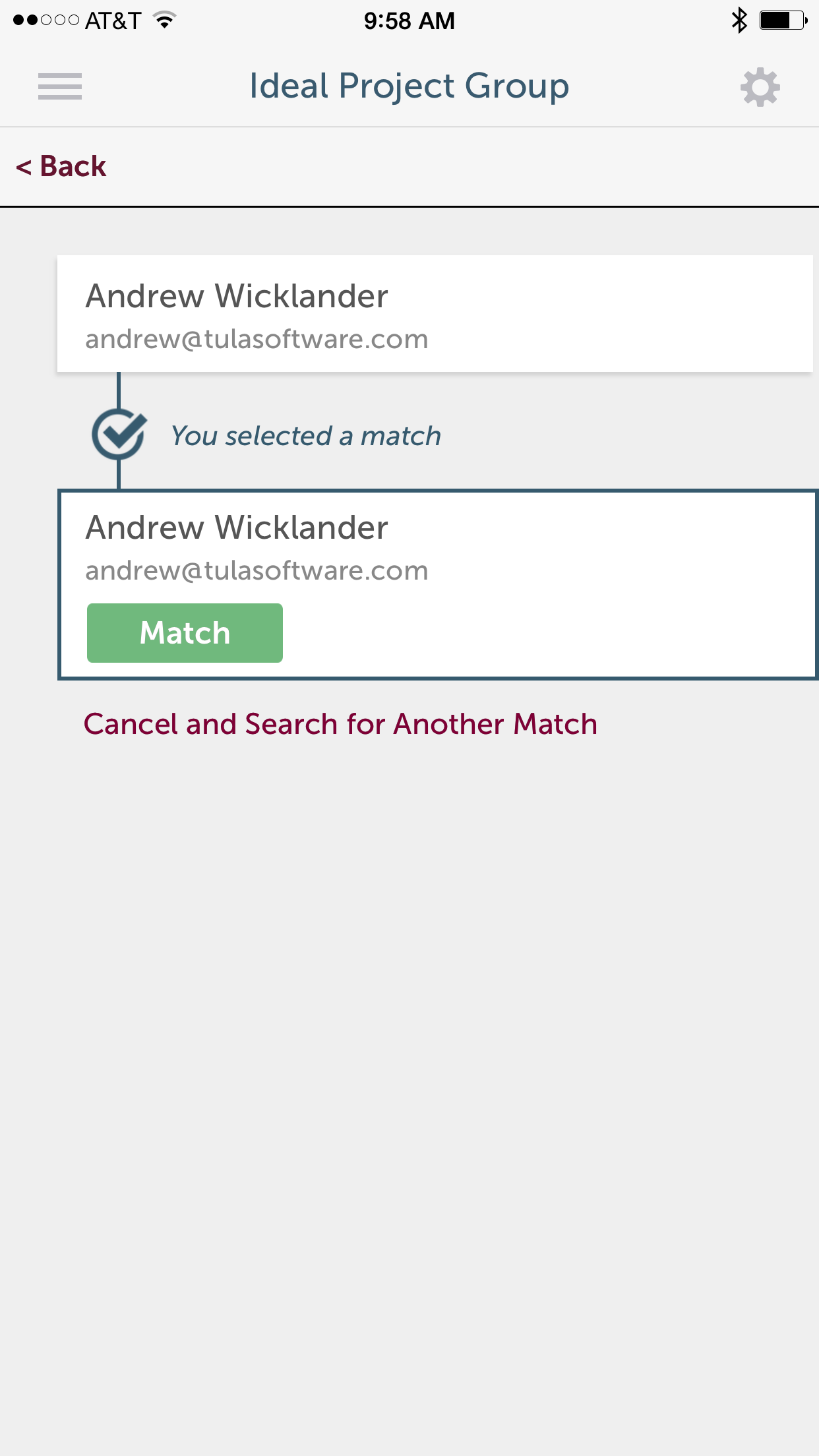
While we've had payment matching in the apps for a while, we hadn't yet brought the matching functionality into the registration side of things. Now we haven, and when a new person signs up for class from your website, you can easily add them right from within the apps:

When someone registers for class and there's no email on file, you'll be prompted to make a match...

When someone registers for class and there's no email on file, you'll be prompted to make a match...

On the matching page, choose to match the incoming registration with an existing student, or add them as a new person... 

On the matching page, choose to match the incoming registration with an existing student, or add them as a new person... 

Confirm your selection and the registration will be complete.

Confirm your selection and the registration will be complete.

We're thrilled with this latest set of updates and you can get the most recent version of the iPhone app here, and the iPad app here.

Blocking the Chasm: How the yoga community slows the adoption of the practice it loves

One of the greatest insights I've learned about business comes thanks to Roger's Bell Curve and the Technology Adoption Lifecycle. This concept explains how new technology products are adopted, the path they go through - from early adopters into the mainstream - and importantly it also explains why some products fail.

Image Courtesy of Wikipedia

For all products that eventually become mainstream, there is a chasm, and crossing this chasm is the key to becoming mainstream. There are loads of other lessons baked into understanding this adoption curve, and I highly recommend reading more about it if you haven't already.

One interesting thing I've noticed about the yoga community, is that unlike the technology industry where we obsess about this chasm, and we do everything we can to build bridges to help our potential customers cross this chasm, the yoga industry unknowingly puts up barriers to crossing this chasm.

I don't think it's done with intention, and I certainly don't think it's done with ill will, but I do believe that by paying attention to these blocking actions the yoga community can collectively introduce, and retain, a lot more people than it is at present.

While it's true that there are more people practicing yoga in America today than ever before, (in 2012 yoga journal commissioned a study that found there were 20.4 million active participants in America) the rate of adoption seems to have slowed the past few years with estimates seeming to hover around 22 million, although it's difficult to find a study more recent than the 2012 study.

In no particular order, here are the things I see the yoga community doing that slow the growth, and reduce the retention rates, of people practicing yoga.

Students (the customer) are Second Class Citizens

In almost every industry, it is the customer that the industry obsesses about. Tech companies obsess about users and their needs. Sports teams obsess about putting a team together that fans want to see. And the yoga industry obsesses about...teachers, and becoming a teacher.

If you are someone who is very into yoga, who wants to dive deeper into yoga and it's origins and truly strengthen your practice, almost every single option is a road that leads to being an instructor. If you are someone who wants to be a deep student of yoga, but you don't have an interest in teaching yoga, the options available to you fall through the floor.

Moreover, if you are someone who has found you enjoy a great asana class twice per week and no more, there are countless people who will happily talk to you about how you aren't a "real" yogi. The level of disrespect I see directed at people who work in the industry but have chosen not to become teachers is something I am regularly stunned by.

Men are not explicitly catered to and they are often outright banned.

Let me share a little insight with you about men: we too have insecurities and we need help dealing with these insecurities. Do you know that a 45 year old man with a beer belly probably feels as uncomfortable next to a skinny 24 year old woman as a new mom does? I never once thought of yoga as a practice that could be meant for me until my wife opened a yoga studio. Something is wildly broken when that's the bar that the industry has set for introducing someone such as myself to yoga.

81% of practitioners are women, and yet I almost never see an event explicitly designed to bring more men into the fold of yoga. Rarely do I see an intro to yoga for men event. Rarely do I see couples events designed to help women introduce their male partners to yoga. I have come across no fewer than 3 events in the past 6 months that I was intrigued by only to learn they were women only events.

Seeing as how men make up 49% of the population and only 19% of existing yoga practitioners, there is no greater opportunity for the growth of yoga than to introduce it to more men. And yet.

Instagram Pictures of Instructors instead of Students

Maile and I talk about things we notice in the industry all the time, and a main topic of late is how rarely we see pictures of yoga teachers teaching yoga. Seriously, when's the last time you saw a really great photo of an instructor helping someone hold a handstand? When is the last time you saw an instructor doing an adjustment on their student? Generally speaking, when it comes to yoga and instagram, it's all about the teacher and not at all about the student.

Applying these lessons to your own business

Like I mentioned early on - I don't think any of this is the result of malice. It's just that often times people forget that in order to grow an industry, you need to make it accessible to new adopters, and that those later adopters need help crossing the chasm.

A good question to ask is: for every existing practitioner you serve, how many non-practicioners are you working to introduce yourself to? Opportunity is abound.

One Million Attendances

On October 1, 2011 at 8:30am, Maile checked the first person into the first class at Tula Yoga Studio using Tula Software, which was also the first attendance recorded in our system. 

Today, a little more than three and a half years later, we have officially logged our one millionth attendance. Yep that's right, 1 million individual instances of a human walking into a yoga class, and having their attendance recorded with Tula. 

In the months leading up to her opening, we were rushing to get something functional up and working that Maile could use from the start. It was a super minimum product, but it worked, and we had Tula up for her first class. 

We thought our idea would work. Our intuition was that the poor software options available, and the pain they caused studio owners, would be felt by others. But we couldn't know for certain whether or not the market would actually respond. The only way to know was to make it, keep building upon it, market it and sell it.

Today we know it's working. Every day there are people deciding between our homegrown software and larger companies that have millions of dollars in funding, and every day people decide to use us instead of them because of the quality of our product and the superior service we're able to provide.

As a private company we don't often celebrate milestones publicly, but we thought 1,000,000 attendances was worth a big hearty thank you to all of our customers - and especially our very earliest adopters - for giving something new a try in an industry that dearly deserved something better.

To everyone that's helped make Tula possible - but especially to our customers - thank you!

The best support, now even better

One of the things we're most proud of at Tula is the amazing customer support we're able to provide. We truly enjoy hearing from our customers, and we make it super easy for our customers to get in touch with us. From inside the browser, our customers can click a button and get ahold of us. No crazy forms to fill out, and no hidden email 5 pages deep in a support site.

With our iPhone and iPad apps though people still had to send us an email to get in touch with us. This worked fine, but we wanted something better. We thought...if we've made it so you can have all of Tula in your pocket, well then you should have instant access to our support channel and support team in your pocket too!

I'm really happy to announce today a new feature available inside both our iPhone and iPad apps that allows our customers to get in touch with us with the same ease as if they were in the browser. Just tap the support button, and you can start a new conversation with us, or view previous conversation history from earlier threads.

What's even better is that all of this is in sync. So you might start a support request in the browser, but then get a push notification 10 minutes later on your phone when you're away from your computer. Or maybe you remember you had a quick question so you tap it out on your phone, but you don't want to review the answer in detail until you're back at your laptop.

Whatever the case may be that you need to get in touch with us, we always want it to be fast, easy and as frictionless as possible. And now this is the case on the browser, iPhone app and iPad app.

We also pushed out a few smaller items with this release including the ability to close a class by swiping left, some small design updates for special events, and some bug fixes. Get the updated apps from the app store today!